| |||||||||||||||||||||
Tuesday, 19 February 2019


Monday, 18 February 2019
Sunday, 17 February 2019

Saturday, 16 February 2019
Amazon TOP UP
| |||||||||||
|
You received this email as a client or subscriber of My Company, Inc.
Our address: |
Friday, 8 February 2019
Wednesday, 16 January 2019
FW:
From: Jayant Arora [mailto:arorajayantc@yahoo.com]
Sent: Wednesday, January 16, 2019 04:30:52 PM
To: drjayantarora.1234@blogger.com
Subject:
Wednesday, 2 January 2019
Saturday, 14 October 2017
Sunday, 7 May 2017
Steroid injections, physio and fish oils: what really works for painful knees?--- Dr Jayant Arora answers some of the common questions his patients ask about knee pain.
It’s not until your knees start hurting that you realise how much work they do. So, which problems should you worry about, and which treatments work and which won't.....
Our knees are a marvel of engineering. They take quite a battering over the course of a lifetime, especially an active one; knees bear our full weight when we’re standing, with extra force when we run, jump, twist, go up and down stairs, kick a ball or run around a tennis court. Little wonder knees are susceptible to short-term (acute) injuries and long-term (chronic) problems such as osteoarthritis (“wear and tear”). Most acute knee problems get better without specific treatment, and the best initial treatment for chronic knee pain is exercise and weight loss.Other options include simple painkillers, physiotherapy, steroid injections, cartilage and ligament repair, and total knee replacement. Claims are made for dietary supplements and spices such as fish oils, turmeric and glucosamine. Newer therapies being investigated include injecting the knee with hyaluronic acid, stem cells or platelet-rich plasma.
Does it matter if my knees pop or crack when I squat?
A popping or cracking noise does not matter if there’s no pain, swelling or difficulty moving your knee. The alarming sound can be caused by air bubbles popping in the joint fluid or ligaments and tendons snapping back into place after moving or catching on bits of bone or cartilage. If you also get pain, swelling or find the knee catches in certain positions, you may have a small cartilage tear. Most minor tears get better without specific treatment within six weeks; if not, see your Doctor.
I have heard people talk about ACL and meniscal tears. What’s the difference?
It helps to visualise the whole knee. The joint between the femur (thigh bone) and tibia (shin bone) is helped by the patella (kneecap) and stabilised by four powerful ligaments, which are fibrous bands between the bones (anterior and posterior cruciate – ACL and PCL – which cross the joint space, and lateral and medial collateral – LCL and MCL – which run down either side of the joint). The strong quadriceps (thigh muscles) are attached to the patella via a tendon and are key to the smooth movement and stability of the joint; strong quadriceps make for strong knees. Cartilage lines the surfaces of femur and tibia to prevent bone grinding on bone, and two cushions of cartilage (menisci) sit in the joint as shock absorbers. Most cartilage and ligament tears get better on their own within a few weeks, but surgical repair is sometimes needed. An ACL tear is a common sports injury that makes the knee painful and unstable. It particularly affects footballers, badminton and tennis players who stop or change direction suddenly or get a direct blow to the knee during a tackle.
I’ve got patellofemoral pain syndrome; should I give up my gym membership?
Patellofemoral pain syndrome often affects young, sporty women and is a fancy name for the dull ache and crunching sound you get at the front of both knees around the kneecap. It can be worse after sitting for a long time, pounding up and down stairs, kneeling or doing squats. Ice packs and anti-inflammatory gel or tablets help in the short-term, and exercises to strengthen the muscles around the knee may solve the problem. You may have to change your exercise regime; walking and cycling in place of running and jumping. Giving up the gym is your call but you would be advised to stay active for your physical and mental wellbeing.
My knees are weak; should I avoid running?
Not necessarily. Professional athletes, runners and footballers certainly get knee injuries as an occupational hazard. But for the rest of us, the evidence suggests that even long-distance running doesn’t increase the chances of developing osteoarthritis. Older runners with mild osteoarthritis don’t seem to make it worse if they keep on running.
I’ve been told that my knee pain is osteoarthritis and there’s nothing I can do. Is that really true?
No, there’s lots you can do, but it’s not about heroics or headline-grabbing new therapies. It’s essential to keep exercising and lose weight. “If people lose weight, their knee pain improves, and if they need surgery, they do better.” People can take a low dose of mild painkillers if they need something to keep active, but use of regular use of opiates and NSAIDS(Brufen, Voveran etc) taken regularly can cause huge problem in the form of dependence or Kidney damage. Steroid injections help some people in the short-term, but injections of platelet-rich plasma, stem cells or hyaluronic acid haven’t been shown to have any long term benefit in arthritis. These may provide short term pain relief and may delay need for surgery by a few months
I get occasional knee pain and my X-ray shows severe osteoarthritis; should I have a knee replacement?
It’s best to treat the person, not the X-ray. X-ray and MRI findings don’t correlate well with symptoms; you can have an awful-looking X-ray but not suffer much pain or stiffness, and vice versa. You should not consider undergoing a knee replacement until your symptoms are severe and you have tried other options such as exercise regimes, weight-loss and painkillers. Rapid developments in technology like robotics, patient specific knee implants etc. mean that partial and full knee replacements are likely to become even safer, more effective and long lasting in the coming years.
Ever since I Googled “knee osteoarthritis” I have been bombarded by things to buy and try. How do I know what works and what doesn’t?
Look at evidence and price. Does it work? Does it cause any harm? Is it worth the money? The trial evidence to date is that acupuncture doesn’t work, but it’s safe and may help some individuals. There’s a lack of evidence for the effectiveness of a Tens machine, but is cheap and safe. Lateral wedge insoles can be bought online and put in shoes to take pressure off the knee; evidence is weak, but they’re cheap, safe and sometimes effective. Glucosamine and chondroitin supplements are popular, but there’s no evidence that they have any benefit in delaying arthritis. The yellow pigment in the spice turmeric (Curcumin) contains chemicals that are said to be beneficial in osteoarthritis, but it’s likely you would have to eat 4-8 capsules a day for any significant effect
What about a steroid injection or Lubricating Gel injection?
Steroid injections alone or with combination with Gels into the knee joint can provide rapid relief from pain, swelling and stiffness. The effect lasts up to three months or more. But the evidence is inconclusive; 44% of people given a steroid injection reported an improvement in pain compared with 31% given a saline injection. The effect is bettter in patients who are sedentary, not obese and with moderate xrays changes of OA. Late stages of arthritis show no improvement in pain with any injection and thesde are a wate of time and money.
Wednesday, 8 March 2017
Knee replacement surgery in Gurgaon by Dr Jayant Arora
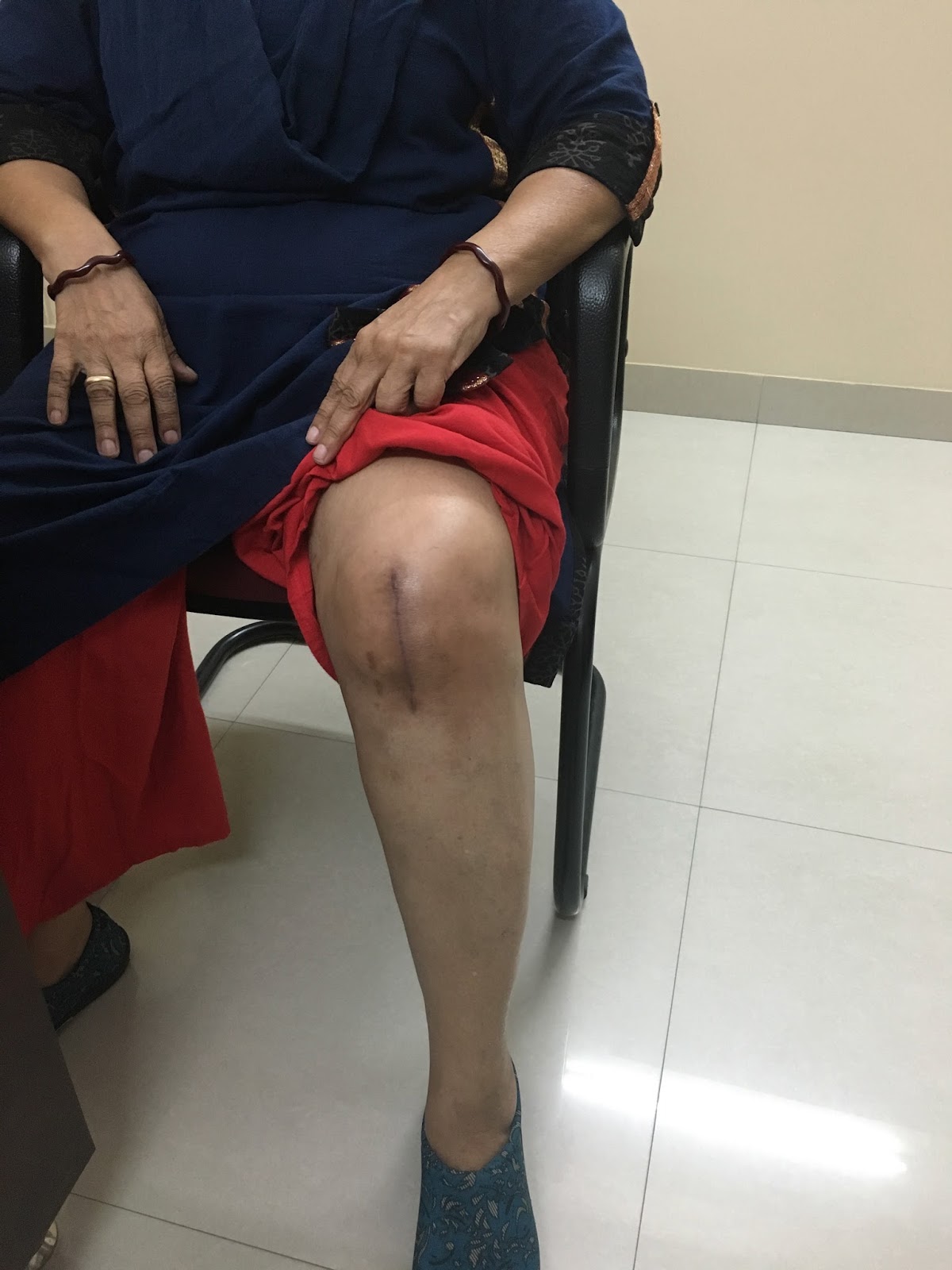
Mr AD, a 67 -year-old gentleman seen two months after his bilateral knee replacement surgery done by Dr Jayant Arora , at Columbia Asia Hospital, Gurgaon. Patient has recovered well and has regained complete movement. This was possible due to advanced surgical techniques and high flex knee implants.


For further information please feel free to contact Dr Jayant Arora at
Dr Jayant Arora
1. Gurgaon Knee and Shoulder Clinic.
Mon-Sat : 5.30- 8.00 pm
570, Sector 56, Behind Jalvayu towers.
For appointments contact 01244214431 or 9999847468 or visit www.gurgaonkneeandshoulderclinic.com
2.Columbia Asia Hospital
Mon - Sat 8.00- 4.00 pm
For appointments 01243989886
Mr AD, a 67 -year-old gentleman seen two months after his bilateral knee replacement surgery done by Dr Jayant Arora , at Columbia Asia Hospital, Gurgaon. Patient has recovered well and has regained complete movement. This was possible due to advanced surgical techniques and high flex knee implants.


For further information please feel free to contact Dr Jayant Arora at
Dr Jayant Arora
1. Gurgaon Knee and Shoulder Clinic.
Mon-Sat : 5.30- 8.00 pm
570, Sector 56, Behind Jalvayu towers.
For appointments contact 01244214431 or 9999847468 or visit www.gurgaonkneeandshoulderclinic.com
2.Columbia Asia Hospital
Mon - Sat 8.00- 4.00 pm
For appointments 01243989886
Tuesday, 7 March 2017
Partial Knee resurfacing-- an excellent alternative to Total Knee replacement surgery.
What Is Partial Knee Replacement?
Dr Jayant Arora explains the benefits of Partial knee replacement. Gurgaon Knee and shoulder Clinic offers Partial Knee replacement to patient suffering from Knee arthritis as an alternative to Total knee replacement.
A partial knee replacement is an alternative to total knee replacement for some patients with osteoarthritis of the knee when the damage is confined to a particular compartment of the knee. In the past, partial knee replacement was reserved for older patients who were involved in few activities. Now, with better implants and improved surgical techniques, more patients are being considered for partial knee replacement compared with a few years ago. About 15% to 20% of patients with arthritic knees are estimated to be eligible for partial knee replacement.
What is a partial knee replacement?
In a partial knee replacement, only the damaged part of the knee cartilage is replaced with a prosthesis.
What are the advantages of partial knee replacement over total knee replacement?
Compared to total knee replacement, partial knee replacement better preserves range of motion and knee function because it preserves healthy tissue and bone in the knee. For these reasons, patients tend to be more satisfied with partial knee replacement compared with total knee replacement, and they are still candidates for total knee replacement should they ever need it in the future. There is also less blood loss during surgery, and knee motion recovers faster with partial knee replacement.
 |
| Small Incision |

What is recovery like?
Because a partial knee replacement is done through a smaller, less invasive incision, hospitalization is shorter, and rehabilitation and return to normal activities is faster.
Patients usually experience less postoperative pain, less swelling, and have easier rehabilitation than patients undergoing total knee replacement. In most cases, patients go home 1 to 3 days after the operation.
You will begin putting weight on your knee immediately after surgery. You may need a walker, cane, or crutches for the first several days or weeks until you become comfortable enough to walk without assistance.
A physical therapist will give you exercises to help maintain your range of motion and restore your strength. You will continue to see your orthopaedic surgeon for follow-up visits in his or her clinic at regular intervals.
You will most likely resume your regular activities of daily living by 6 weeks after surgery.
People undergoing partial knee replacement surgery, in which only the parts of the knee affected by osteoarthritis are removed, have fewer complications, are less likely to be readmitted to hospital and less likely to have serious complications, the researchers found.The main benefit of the partial knee is that it provides better function.
Friday, 15 August 2014
We are one of the first centers in Gurgaon to offer knee replacement using Patient Specific instrumentation (PSI) or Custom made instruments.
PSI uses advanced imaging to generate one-time-use instruments specific to each patient. A computed tomography (CT) or magnetic resonance imaging (MRI) scan is taken of the patient’s leg. A three dimensional bone model of the patient's knee is created based on the CT/MRI images. Dr Arora will then plan your surgery on this 3D image regarding overall alignment, femoral and tibial bone cuts and size of the implant needed. The detailed plan is then sent to the implant manufacturing unit based in USA and an engineer uses the data to fabricates a corresponding set of disposable cutting blocks or pin guides designed to help the surgeon position and align the implant during surgery. These jigs are then shipped to us for use during surgery.
These patient-specific surgical instruments are custom made for the precise alignment of patient’s knee.There are several distinct advantages of this technology. It removes multiple steps from the traditional surgical technique and shortens surgical time as most of the planning about size and placement of implants takes place preoperatively using computer software programme. This may lead to less blood loss and a lower risk of infection.
Patients are counseled about this technique at the clinic and once they have decided to proceed with custom made implants, an MRI/CT scan of the knee(s) is arranged at a designated center in Gurgaon.
The images are sent to USA/ Belgium for fabrication of patient matched bone cutting instruments. They are received after 2-3 weeks, following which the surgery can be done.
Video below explains the process of PSI in detail.
PSI uses advanced imaging to generate one-time-use instruments specific to each patient. A computed tomography (CT) or magnetic resonance imaging (MRI) scan is taken of the patient’s leg. A three dimensional bone model of the patient's knee is created based on the CT/MRI images. Dr Arora will then plan your surgery on this 3D image regarding overall alignment, femoral and tibial bone cuts and size of the implant needed. The detailed plan is then sent to the implant manufacturing unit based in USA and an engineer uses the data to fabricates a corresponding set of disposable cutting blocks or pin guides designed to help the surgeon position and align the implant during surgery. These jigs are then shipped to us for use during surgery.
These patient-specific surgical instruments are custom made for the precise alignment of patient’s knee.There are several distinct advantages of this technology. It removes multiple steps from the traditional surgical technique and shortens surgical time as most of the planning about size and placement of implants takes place preoperatively using computer software programme. This may lead to less blood loss and a lower risk of infection.
Patients are counseled about this technique at the clinic and once they have decided to proceed with custom made implants, an MRI/CT scan of the knee(s) is arranged at a designated center in Gurgaon.
The images are sent to USA/ Belgium for fabrication of patient matched bone cutting instruments. They are received after 2-3 weeks, following which the surgery can be done.
Video below explains the process of PSI in detail.
Monday, 10 February 2014
Oxynium Knee Replacement in Gurgaon by Dr Jayant Arora
Rheumatoid arthritis can lead to crippling deformities in joints and unlike osteoarthritis which is seen in elderly population, it can affect us at any age. Rheumatoid arthritis is the second commonest type of arthritis due to which patients require a knee replacement surgery world wide.
Despite many advances in the medical treatment if this disease, severe joint damage can happen in-spite of medications and often such patients have to undergo replacement surgery of multiple joints for pain relief and to regain normal functional life.
We would like to share a story of thirty seven year old courageous school teacher suffering from crippling rheumatoid arthritis, that affected her at the age of seventeen.
The disease was aggressive and inspite of regular medications, she developed painful and stiff joints. She braved her condition with steely determination and a smile on her face. The disease progressed relentlessly, affecting both the knees. Gradually, the knees developed deformities, became very stiff and remained painful even at rest. Both the knees lost all the movement and were fixed in a bent position. She had started walking laboriously with a marked limp. This was affecting her physically as well as emotionally and she had started losing the mental battle against the crippling disease. In her quest to remain mobile, she tried rigorous physiotherapy and even took injections in the knee joints, all without any improvement in her condition. She visited us at Gurgaon Knee and Shoulder Clinic to consult Dr Jayant Arora, where the option of knee replacement surgery was discussed with her as a last resort to restore movements, relieve pain and improve walking. She was explained, that unlike most knee replacements, her surgery was not going to be straightforward and there were several issues that needed to be addressed. Since, she was nearly half the age as compared to a typical patient under going knee replacement, knee replacement made from a special material (Oxynium) was used instead of a standard metal implant. Oxynium implants are preferred in young patients undergoing knee replacement as that are stronger than metal implants and are expected to last longer. Our vastly experienced Surgeon performed the replacement of both knees at Columbia Asia Hospital using a modified surgical technique to account for stiff and tight muscles,deformed and weak bones. The rehabilitation was carefully planned and done under regular supervision, leading to a very quick recovery. Her colleagues were left amazed when she resumed working three months after surgery, able to walk normally, climb stairs and drive, as if there was never anything wrong in her knees. The only thing that didn't change was her infectious smile!
Subscribe to:
Posts (Atom)